
Researching Yemeni coffee varieties is a topic of great interest to specialty coffee lovers worldwide, given Yemen's historical significance in the coffee world. Yemen is known as one of the oldest countries to cultivate and export coffee across the globe. With the growing interest in premium coffee, understanding the different types of Yemeni coffee has become essential for anyone seeking unique flavors and exceptional experiences. Many coffee enthusiasts follow specialized platforms like Drip On to find diverse information about products, markets, and opportunities, while Yemeni coffee remains a symbol of authenticity and quality in the coffee industry.
A brief history of Yemeni coffee
Before discussing the different types of Yemeni coffee , it's important to understand the historical roots of this unique product. Yemen has played a pivotal role in the global spread of coffee for centuries, with the renowned port of Mocha serving as a major center for exporting coffee to Europe, Asia, and Africa.
The name "Mocha" or "Makha" has become synonymous with premium Yemeni coffee, and a global term signifying quality and excellence. Even today, Yemeni coffee maintains its prestigious position among the world's finest coffees.
What makes Yemeni coffee special?
Yemeni coffee varieties are distinguished by several characteristics that set them apart from many other types of coffee, most notably:
- Agriculture in mountainous highlands.
- Relying on traditional farming methods.
- The great variety of flavors.
- High quality grains.
- Relatively limited production.
- Manual care of the crop.
These factors combined give Yemeni coffee a unique character that is difficult to replicate anywhere else.
The most famous coffee-growing regions in Yemen
To understand the types of Yemeni coffee more deeply, one must learn about the most prominent regions that produce it.
1. Haraz region
Haraz is one of the most famous coffee-producing regions in Yemen, and it is located in the western highlands.
Coffee beans from this region are characterized by:
- Complex fruity flavors.
- Balanced acidity.
- Distinctive floral scents.
2. Bani Matar region
It is famous for producing high-quality coffee beans used in many luxury blends.
Its most prominent characteristics include:
- Chocolate flavors.
- Caramel touches.
- Balanced texture.
3. Yafa'a region
It produces distinctive types of coffee with a unique character, characterized by:
- Fruity flavors.
- Natural sweetness.
- Attractive aromatic scents.
4. Anse region
It is one of the regions that contributes to the diversity of Yemeni coffee varieties thanks to its unique geographical nature and its elevations suitable for coffee cultivation.
The most famous types of Yemeni coffee
When talking about the types of Yemeni coffee , we find many varieties that differ in their characteristics and flavors.
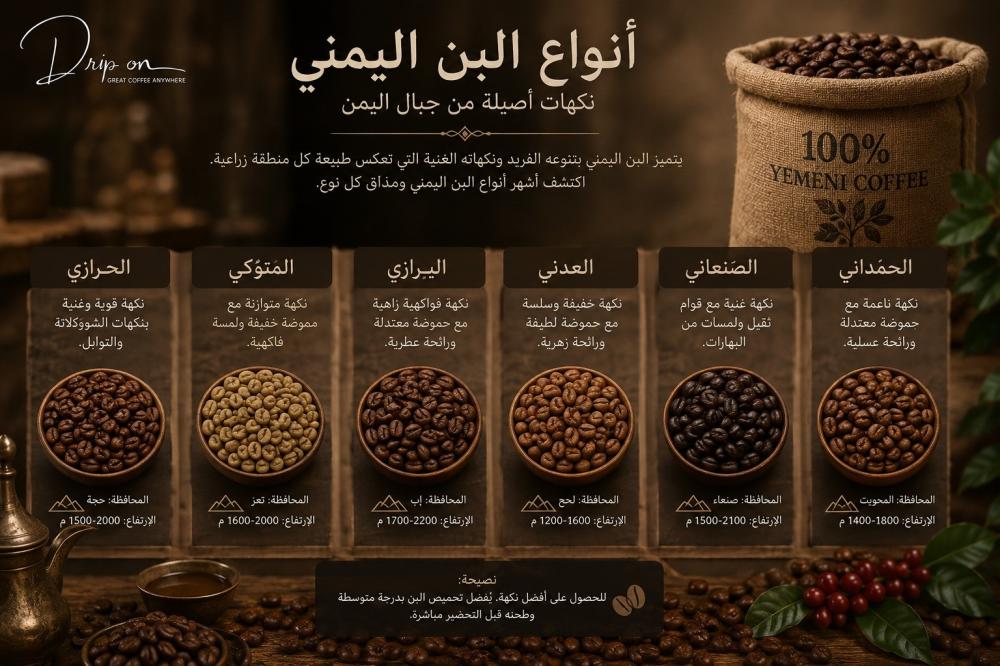
Harazi coffee
It is considered one of the most famous and sought-after types of Yemeni coffee.
Its advantages include:
- A complex and balanced flavor.
- Floral scents.
- Mild acidity.
Rain coffee
It comes from the Bani Matar region and is known for its high quality.
It is characterized by:
- Medium consistency.
- Chocolate flavors.
- A rich and distinctive taste.
Yafe'i coffee
One of the most prominent types of Yemeni coffee that enjoys widespread popularity.
It is characterized by:
- Prominent fruity flavors.
- A perfect balance.
- Long-lasting taste.
Ansi coffee
It is highly regarded among specialty coffee lovers.
Among his most prominent qualities:
- The taste is smooth.
- Natural sweetness.
- Aromatic complexity.
Characteristics of Yemeni coffee flavors
Yemeni coffee beans are characterized by a great variety of flavors, the most prominent of which are:
- Dark chocolate.
- Dried fruits.
- Spices.
- Caramel.
- Nuts.
- Natural honey.
The appearance of these flavors depends on:
- The agricultural area.
- Height.
- Method of processing.
- Roasting method.
Methods of processing Yemeni coffee
Processing plays a key role in highlighting the characteristics of Yemeni coffee varieties .
Natural treatment
It is the most common in Yemen.
And it contributes to:
- Increased sweetness.
- Enhance fruity flavors.
- It gave the coffee a richer texture.
Traditional dried processing
It relies on drying the beans under the sun, which gives the coffee a unique character that distinguishes it from many other types of coffee worldwide.
Comparing Yemeni coffee with other types of coffee
When comparing Yemeni coffee varieties with some internationally famous varieties, several important differences emerge.
Comparison with Ethiopian coffee
Ethiopian coffee is often characterized by more pronounced floral and fruity flavors, while Yemeni coffee offers greater depth and higher complexity.
Comparison with Colombian coffee
Colombian coffee tends towards balance and smoothness, while Yemeni coffee offers a bolder and more distinctive character.
Comparison with Brazilian coffee
Brazilian coffee is known for its nutty and chocolatey flavors, while Yemeni coffee varieties are characterized by a greater aromatic diversity.
The best ways to prepare Yemeni coffee
Yemeni coffee can be enjoyed in several different ways.
V60
Highlights:
- subtle flavors.
- Balanced acidity.
- Aromatic scents.
Chemex
It helps produce a clean, clear, and flavorful cup.
French Press
Suitable for those who prefer a rich texture.
Espresso
Some types of Yemeni coffee produce exceptional results when prepared as espresso.
How to choose the best Yemeni coffee
If you wish to buy the best types of Yemeni coffee , be sure to consider the following:
Roasting date
The newer the roasting, the more pronounced the flavors.
Source of coffee
Choose products that accurately indicate the agricultural area.
Roasting level
- The opener to highlight the original flavors.
- The mean to achieve balance.
- Dark for lovers of strong flavor.
Treatment method
It directly affects the final taste.
Benefits of Yemeni coffee
Besides their distinctive taste, Yemeni coffee varieties offer many potential benefits.
Improving focus
Natural caffeine helps to boost alertness.
Rich in antioxidants
Coffee contains beneficial compounds that may help fight free radicals.
Boosting activity
It can contribute to increased energy levels throughout the day.
A unique sensory experience
Yemeni coffee offers a rich variety of flavors and aromas.
Challenges facing Yemeni coffee production
Despite the global renown of Yemeni coffee varieties , the sector faces a number of challenges, such as:
- Limited water resources.
- The difficult mountainous terrain.
- High production costs.
- Global competition.
However, the Yemeni product still maintains its distinguished reputation thanks to the high quality of the grains.
The future of Yemeni coffee
Global demand for Yemeni coffee varieties is witnessing continuous growth, especially with the increasing interest in specialty coffee and rare coffee sources.
Many entities are striving to:
- Supporting farmers.
- Developing supply chains.
- Improving export processes.
- Enhancing the global presence of Yemeni coffee.
These efforts contribute to maintaining Yemen’s position as one of the most important countries producing high-quality coffee.
Tips for enjoying the best experience
To get the most out of Yemeni coffee beans , follow these tips:
- Use fresh grains.
- Grind the coffee just before preparing.
- Use purified water.
- Try more than one method of preparation.
- Write down your observations about the different flavors.
- Choose high-quality preparation tools.
Yemeni coffee is considered one of the world's most prized treasures, combining a rich history, exceptional quality, and complex flavors rarely found elsewhere. Whether you're a specialty coffee enthusiast or simply seeking a unique and memorable experience, exploring Yemeni coffee will unlock a world of distinctive aromas and flavors. By understanding the producing regions, processing methods, and proper brewing techniques, you can savor an authentic cup of Yemeni coffee that reflects a centuries-old heritage.